Germanium
 |
Download Germanium Datasheet (PDF, 70 KB) |
Among other materials for IR applications Tydex uses Germanium showing good transmission in 2-15 µm range. Due to high refractive index Ge lenses became very useful components of IR imaging systems operating in both “atmosphere windows”: 3-5 and 8-12 microns.
Both monocrystalline and polycrystalline Ge may be used for manufacturing of optical components. We produce Germanium lenses and windows for infrared thermal imaging applications and pyrometry (see our webpage Germanium windows and lenses for thermography). Also such components for spectroscopy as ATR prisms, detector windows, and IR Polarizers are available.
Ge is also good electromagnetic interference (EMI) shielding material. Its special grade called EMI for its ability to shield against electromagnetic interference has become increasingly important for modern military applications where other signals (within millimeter and centimeter range) can be strong enough to make nearby IR systems ineffective. Typical resistance for EMI grade Germanium is about 4 Ohm x cm but it depends on required level of spurious signal suppression. Using Ge window with such resistance these signals are effectively shorted out and the IR system shows good performance.
Below you can find list of main properties of Germanium as well as its transmission and absorption spectra.
Tab. 1. Physical properties of Germanium
|
Tab. 2. Thermal properties of Germanium
|
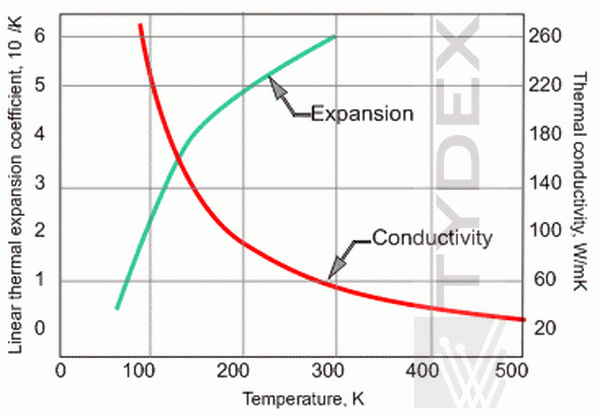
Fig. 1. Linear thermal expansion coefficient and thermal conductivity of Germanium vs temperature.
Tab. 3. Electronic properties of Germanium
|
Tab. 4. Chemical properties of Germanium
|
||||||
Thickness of Germanium window required to withstand pressure differential at opposite sides may be calculated by the following equation:
Thk = √( 1.1 x P x r² x SF/MR),
where:
P = Pressure difference (PSI),
r = Unsupported radius (mm),
SF = Safety factor (4 to 6) (suggested range, may use other factors),
MR = Modulus of rupture (PSI).
For example window with diameter 100 mm and unsupported radius 45 mm used in environment with pressure differential of 1 atmosphere should have thickness of ~4.0 mm (safety factor 5).
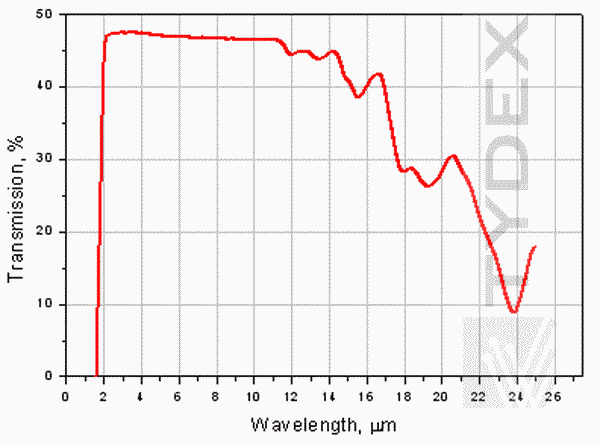
Fig. 2. Typical optical grade Germanium transmission (sample thickness – 2 mm)
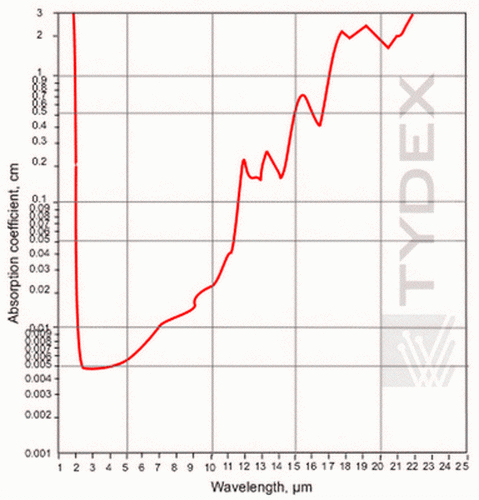
Fig. 3. Typical Germanium coefficient of absorption
Germanium exhibits low absorption of infrared radiation in wavelength range of 2 to 12 µm. The band gap of 0.67 eV in Germanium is responsible for the increase in absorption in the short wavelength range. The lattice (phonon) absorption bands are responsible for the long wavelength absorption.
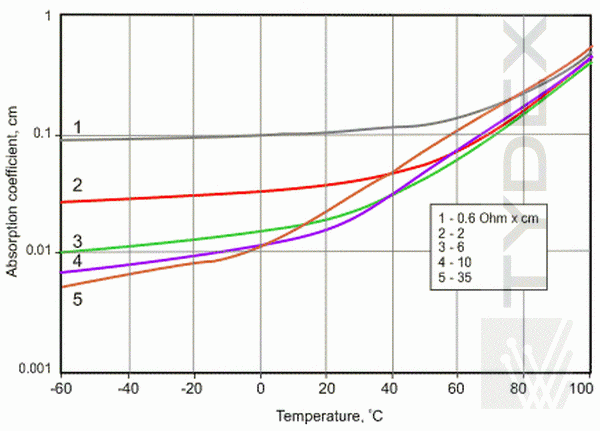
Fig. 4. Absorption vs temperature at 10.6 micron
At high temperature optical grade germanium is subject to excessive absorption due to increased number of thermally generated holes. As it can be seen from spectra absorption growth becomes important at temperatures over about 45°C.
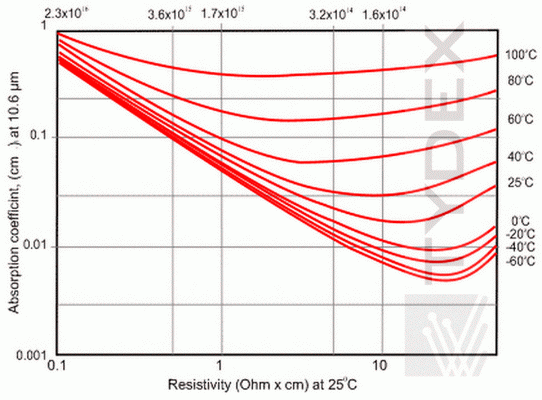
Fig. 5. Absorption vs resistivity of Germanium
Free carrier (electron and hole) absorption and lattice (phonon) absorption account for the IR absorption in the optical range. Holes in Ge absorb more energy than electrons in this range. For nearly electrically neutral Ge, number of holes times number of electrons is constant. The number of holes present can be reduced by increasing the number of electrons by the addition of group V atoms (donors) to the Ge. This lowers resistivity. Excessive addition of donors leads to excessive electron concentration and increased absorption.
Tab. 5. Refractive index of Germanium
|
Usually material with the following properties is used for optical component manufacturing:
Tab. 6.
|
Different shapes of optical components are available – spherical, elliptical, rectangular, plano-plano, plano-convex/concave, meniscus, wedges, rods. Overall dimensions available – from 2 mm to 250 mm for monocrystal and to 300 mm for polycrystal.
Please pay attention that this article is only for your information. We do not supply Germanium in blanks or as raw material. Our standard products are finished (polished, coated) parts.
For price quotation and delivery please fill in our request form.
Optics is ready to be shipped!
Optics Stock
Shipment/ Payment/ Warranty ...